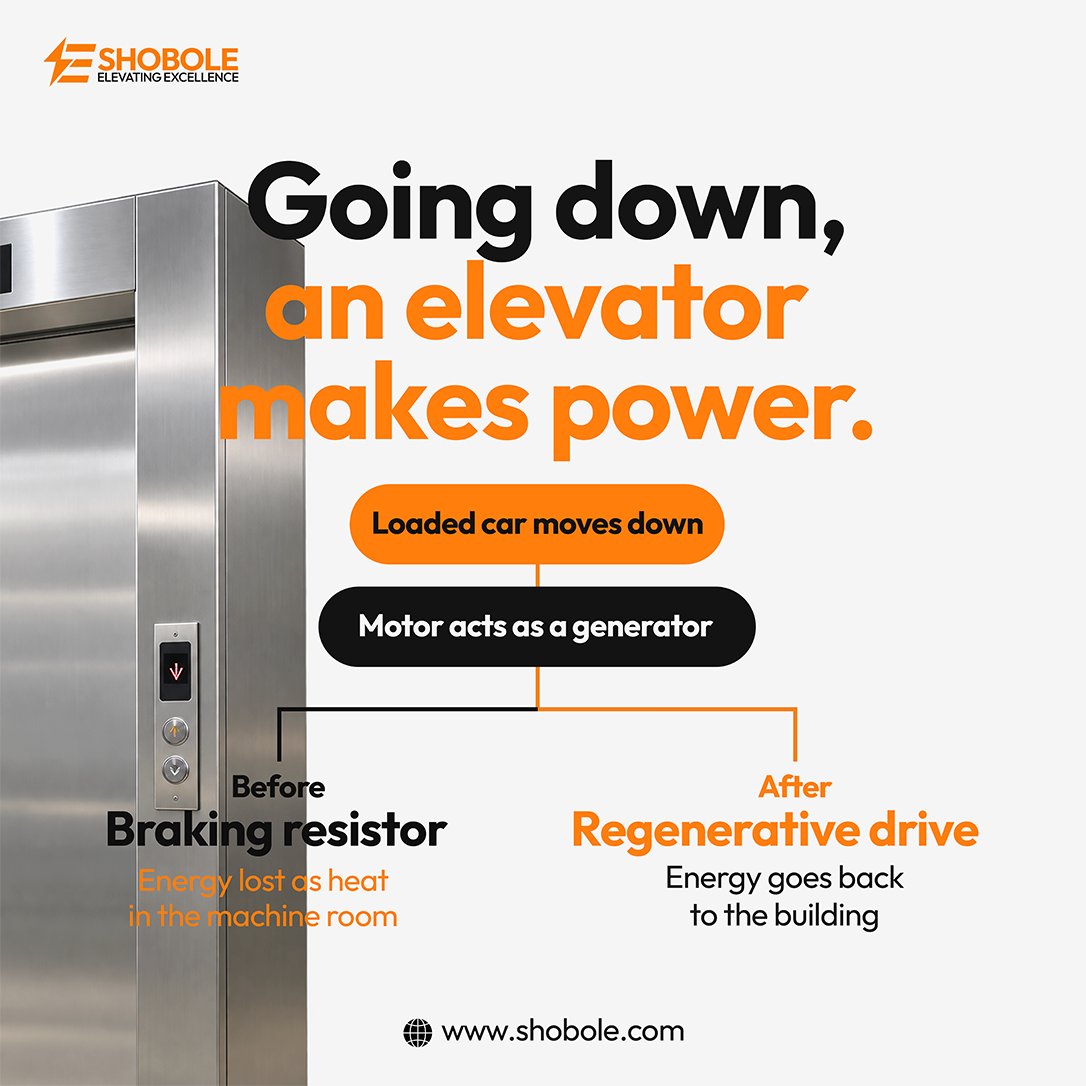
Elevators use electricity to go up. What most people don't realize is that they can also produce electricity on the way down. A regenerative drive is the part that captures it.
The mechanism, in three steps
1. Gravity does the work.
In a traction elevator, a counterweight balances the car. When a fully loaded car goes up, the building supplies power to the motor. When that same loaded car goes down, it regenerates energy instead: the stored energy in the moving system is converted back into electrical energy.
2. The motor becomes a generator.
On the way down, the drive uses electrical braking to control the car's speed. During that braking, the motor essentially acts as a generator. The same thing happens with an empty car going up, because the counterweight is then heavier than the car.
3. The energy goes back to the building.
A regenerative drive feeds this energy back into the building's electrical system, where other loads such as lighting or HVAC can use it. In a building with several elevators, a loaded car going down can supply part of the power for another car going up.
What happened to this energy before
In drives without regeneration, this energy was sent through a braking resistor and dissipated as heat. That wasted the energy, and the extra heat in the machine room often added cooling costs on top.
When it generates power
The motor generates power when the elevator travels up with a light load, travels down with a heavy load, and during deceleration.
Why it matters
Regenerative drives don't create free energy. They stop useful energy from being thrown away as heat, which can lower operating costs and reduce heat in the machine room. 📞 +251-953-577-777
📞 +251-953-677-777